Despite many trips to Japan over the years, the thought of watching sumo wrestling never really crossed my mind. In hindsight, this is a bit strange as I’d at least done a little research on the feasibility of enjoying other Japanese pastimes, such as watching a kabuki performance or some rakugo, and I’ve watched a number of Japanese baseball games while over there. Sumo is the national sport of Japan, yet until last year, the only real encounter I’d had with it was when a couple of wrestlers happened to leave the same bullet train as me.
In July 2024, while flicking through the channels on the tiny hotel television, I came across a live broadcast of the yearly Nagoya tournament. This was the first time I’d ever actually seen the sport in action; my very limited knowledge of the sport being whatever I’d picked up via osmosis. I knew there were big guys trying to throw each other out of a ring, but that was about it. Oh, and whatever I’d seen in You Only Live Twice.
As a bit of entertainment in the hotel following busy days as a tourist, it was quite fun! It was put on the TV a few times during the trip, and I enjoyed all of the ceremony involved, as well as trying to suss out the less-obvious rules. I’ve never been a fan of combat sports, but while the clashes, thrusts and throws are certainly pretty brutal, there’s something quite endearing about the fight ending immediately when the opponent goes down or leaves the ring. The winner will often pull back and try to prevent any unnecessary force once a win is secured.
Still, despite this brief experience with the sport, I’d mostly forgotten about it by the time I got back home. It wasn’t until a few months later when Twitch threw a sumo live-stream in front of me that I started to get a bit more invested.
It turns out that there’s a huge community of fans outside of Japan that congregate towards live-streams and highlight videos. The streamer that showed up in my own feed, MidnightSumo, regularly attracts thousands of viewers. People were showing up in droves to cheer for their favourite wrestlers, celebrate good fights and predict how each 15-day tournament would play out. To be clear, the existence of such a large foreign following shouldn’t have been surprising, but seeing so many fans in one place was quite an eye opener nonetheless.
After a few nights watching top division fights, I started finding my own favourites. For me, this would be wrestlers that focussed on technique versus raw strength. Hoshoryu, one of the two active wrestlers who have reached sumo’s highest rank of yokozuna, is a grappling specialist who is far more likely to throw his opponent into the front row of the audience than he is to push them out. Ura, a mainstay of the top division and the wrestler in the pink mawashi in the video below, is known for winning matches with rarely-used techniques. Watching a wrestler pull a reversal out of seemingly nothing has become one of my favourite aspects of the sport.
This isn’t to say that the powerful wrestlers aren’t fun to watch, however. The wrestler Ura is fighting in the video above, Takayasu, is known for unleashing a constant flurry of slaps on his opponents like a real-life E. Honda. The other active yokozuna, Onosato, is an absolute bulldozer of a man who often pushes his opponent out of the ring before they get a chance to do anything.
My absolute favourite wrestler at the moment is Aonishiki, and if you’ve happened to see any news about the sport this year it probably has to do with him. This man has been on an incredible run since his debut in 2023, smashing a number of long-standing records in the process. Wrestlers will rise up the ranks so long as they win more than they lose in each of the six yearly tournaments; at least 4 wins out of 7 in the lower divisions, and 8 wins out of 15 in the top two divisions. Since he started, Aonishiki’s tournament records have all been positive, and this year alone he did not dip below 11 wins and 4 losses. His hot streak has not only allowed him to climb to the top division of the sport, but also to the top of the top division.
A huge part of his success, and why he’s so entertaining to watch, is due to his fighting style. Aonishiki is incredibly technical, and like Ura, has been known to use less common moves to get himself out of a pinch. He keeps a very low stance, making him tricky to push and grab while keeping his centre of gravity close to the ground. He also uses many freestyle wrestling and judo techniques, having practised the sports along with sumo while he was younger. In the video below, you can see him (on the right in the navy blue mawashi) using the rarely-seen uchimuso move on Kotozakura, an absolute tank of a man and a wrestler ranked at ozeki, the second-highest in the sport.
All of this aside, it’s hard not to root for the young man as he’s a Ukrainian that left his country due to the war. Having competed in amateur sumo events for Ukraine, he was able to call on Japanese acquaintances to join a sumo stable with the view of turning professional.
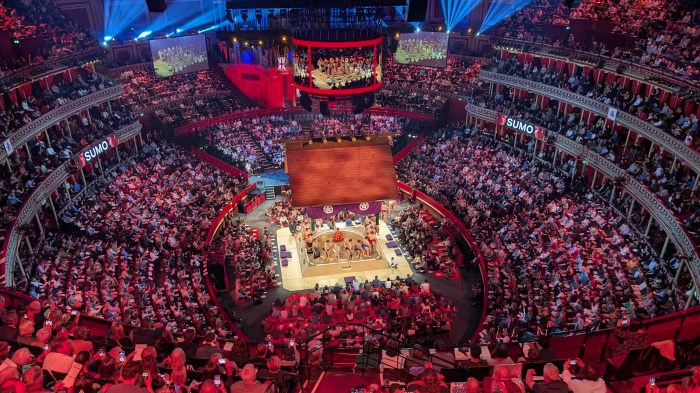
I’d be fortunate enough to watch him wrestle in person, as in October, sumo’s top division travelled to London for a 5-day exhibition tournament. This is particularly notable because there hadn’t been an exhibition outside of Japan for 20 years – so I couldn’t let the opportunity pass! That was easier said than done, however, and it wasn’t until the fourth time that additional tickets were released that I managed to secure a spot. I’d be up in the nosebleeds of the Royal Albert Hall, but I’d be there for day four.
Something I didn’t expect was just how wild the audience would get for the fights. Despite the majority of people in the room experiencing their first taste of sumo, they sure were going wild seeing the wrestlers throw each other around the ring. I was stood next to a group of five friends who were all placing bets on ‘which colour’ would win – repeated losses meant it was their turn to buy the next round. You can hear the energy of the crowd in the live BBC coverage of the event, but as I suppose is always the case when it comes to sports, the broadcast doesn’t quite do the atmosphere justice.
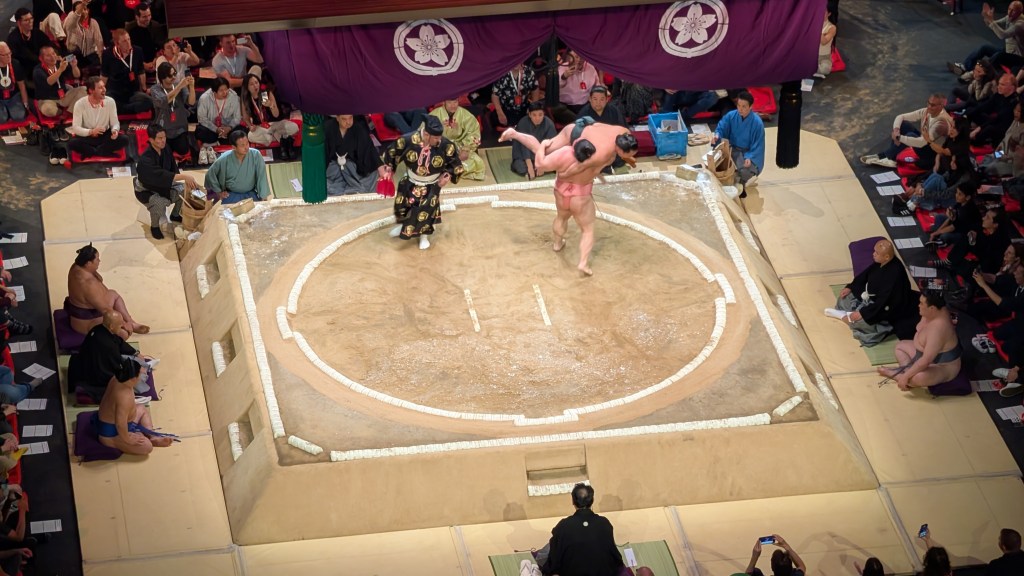
I had a great time, though there is a mild caveat that the wrestlers were not fighting at 100%. This is because these exhibitions don’t count as a regular tournament as far as promotions and demotions in the rankings go, so there was no real desire to go out and get injured right before the next major tournament in November. Totally understandable, and to stress, the fights were still plenty entertaining. As much as I loved watching Ura pick up Midorifuji and dumping him out of the ring (below), this isn’t really something you would see in the top division.
By the November tournament, Aonishiki had climbed into the sanyaku; the three special ranks beneath the top rank of yokozuna. It was his first tournament as a sekiwake, the third-highest rank in the sport, and fans were excited to see if he’d once again pull off an 11-4 tournament. There’s a special requirement for reaching the second-highest rank of ozeki, and uh, it’s complicated. The kind of complicated where you can make a 45-minute deep-dive into the statistics behind all the previous promotions to the rank. There are other factors at play, but the general goal is to earn 33 wins across three consecutive tournaments while inside the sanyaku ranks.
Another 11-4 for Aonishiki would put him right on this 33 mark, so there was heavy discussion between the end of the September tournament and the tournament in November about whether he would be in with a shot, notably because his first 11-4 that would be used for this was at the highest rank beneath the sanyaku. What was causing the discussion is that there are examples of wrestlers having pre-sanyaku records counted in their ozeki runs, but this conversation was essentially killed when an elder at the Japan Sumo Association said that the first 11 wouldn’t count.
Nonetheless, despite what this elder said, people remained adamant that he’d be eligible for ozeki promotion following the November tournament should he perform well enough. It probably wouldn’t happen with another 11-4, but something like a 12-3 and being tournament runner up, or better yet, claiming his first top division victory. Suffice to say, he had a stormer of a tournament. He finished at 12-3, forcing a play-off match against yokozuna Hoshoryu. The winner would take home the Emperor’s Cup.
I don’t think I’ve ever been so excited during a sporting event. I’d been watching most of day 15’s fights fairly casually, but after Aonishiki forced the play-off, I remember setting the stream up in my living room and being fixed to it. Not only was this a chance for Aonishiki to claim his first top-division championship, but it was also the evidence the JSA needed to reconsider their stance on a possible ozeki promotion. In an extra bit of added drama, Hoshoryu’s opponent for day 15, rival yokozuna Onosato, had pulled out due to an injury he’d picked up a few days earlier. The default victory meant that the yokozuna would have been guaranteed the trophy with an Aonishiki loss, but would fight his first match of the day in a play-off following Aonishiki’s win.
Aonishiki, after being pulled forward by Hoshoryu in an attempt to unbalance him, immediately took advantage of the extra momentum by slipping behind the yokozuna. Being grabbed and thrown from behind is game over for even the best of wrestlers, and as such the young Ukrainian ends 2025 with his first Emperor’s Cup. I quite literally screamed at the TV when I watched it happen. Never would I have thought that watching a match of sumo would get the ol’ ticker palpitating.
The ozeki promotion was indeed reconsidered, and shortly after the tournament Aonishiki became the fourth European wrestler in history to make the sport’s second highest rank. So far, no European has made the rank of yokozuna. To reach that rank, you must first be at the rank of ozeki, then win two consecutive tournaments. In some instances, one win and one runner-up tournament has been enough to get the promotion. The man is only 21 and quite literally has most of his career ahead of him, yet people frequently discuss whether 2026 will be the year where we see a European yokozuna.
So yeah, this is the hole I fell down this year. I’m now at the point where I’m making sure that my next trip to Japan, whenever that might be, will coincide with one of the six yearly tournaments so I can at least try to experience the real thing. Until then I’ll continue to watch live-streams and highlights, because this sport has made a fan out of me.
Have a great 2026 everyone!


 The Glorio Blog