
This will be relevant. Eventually. (Cosplay by Nina Yasmine)
The word “fan” has a reputation not many other words can boast. It is one of the only words can can be used both as a proud brag and as a horrible insult, and within the confines of that little category, the only one you are actually allowed to say on state television. Fans are some of the most admirable, yet also some of the most reviled creatures on the planet. They come in all shapes and forms, ranging from the most casual to the most hardcore, from the most analytical to the most vapid and from the most creative to the most unsatisfiable. Most people draw the line where being a fan goes as far as to your favourite book, movie, game, anime or TV show influencing your thoughts, but very often, taking your imagination beyond where the story ends unlocks creative talents you never knew existed.
Fan works are very often associated with subpar drivel no one in their right mind would bother with. Doujinshi still suffer from the stigma of cheap porn — though frankly not unjustified —, fan fiction is still regarded as nothing but terribly-written self-insert dross and — admit it — no one really listens to fan dubs for their own entertainment. Yet these efforts are essential to the people who make them. When Andrew Hussie, creator of the immensely popular webcomic Homestuck, announced that those who considerably funded his Kickstarter project would see their own created character making a canon appearance, the budget counter erupted. Creating fan-driven, or “fanon” content based on a franchise you love dearly inspires people to start writing, drawing, cosplaying, or playing music themselves. Very often, the results serve more as a confidence booster, or wish-fulfilling fantasy for the author then as quality entertainment for those few potential readers; however when truly creative and skilled people get their hands on a fan project, sparks will fly.

Science!
In 2005, a little Gameboy Advance game named Gyakuten Saiban, or Phoenix Wright: Ace Attorney for those less proficient in Japanese, made its way onto the Nintendo DS. The updated rerelease of the game featured a bonus fifth case named Rise from the Ashes. Not only did it contain graphics and gameplay mechanics befitting of the new system, it also featured a clever and intriguing, dark story that saw the titular Ace Attorney Phoenix Wright tearing down a corrupt conspiracy amongst the ones supposed to enforce the law. It still stands as my favourite Ace Attorney case to this day.
What made Rise from the Ashes so compelling were the little details that perfected the Ace Attorney formula. Gone was the black-and-white morality and the idealistic view on law enforcement. Rise from the Ashes featured tragic, ambiguous, and truly terrifying characters and situations, without ever relinquishing the fun and charm of the original four cases. What characterized Rise was a constant, looming sense of dread and a feeling that lives truly were at stake here. Everyone could have been the killer, and when the truth finally arose, the real culprit did not go down without a truly epic battle of wits. It was a legendary final boss fight without even a single blow being exchanged.

And then this happened.
Phoenix Wright’s career as an attorney eventually came to the end, but he gained a worthy successor in rookie lawyer Apollo Justice. Apollo Justice: Ace Attorney, the fourth game in the series, was a great game, supported by many of the new gameplay elements introduced by Rise from the Ashes, but many people felt it lacked something. Throughout the entire game, Apollo never really managed to escape from Phoenix’s shadow, nor did he get to tackle cases as epic in scope as some of his mentor’s finest. Looking for a true epic final case to wrap up Apollo’s story, a French fan named Ping decided to retool an idea for an Ace Attorney fangame that had been playing in his head for a few years into a single case — a case that was to become the Rise from the Ashes of Apollo Justice’s career. He gained help from writers, spriters and scripters from all corners of the Internet and after two years, their project managed to do something very few other fan projects do: It got released.
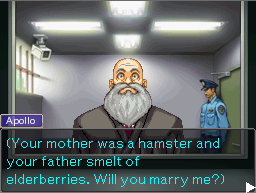
It goes downhill from there.
Turnabout Substitution takes place a few months after the end of the fourth game. Apollo returns from his birthday party, only to find out that Phoenix, Trucy and Thallasa Gramarye have left on a vacation to Borginia. When he stumbles back into the office, he finds out that his ever trolling mentor has issued an application for a new legal aide. The sole candidate seems to be a sassy twentysomething named Rhea Wits. Completely in line with previous assistant characters, Rhea is curious, peppy and cheerful airhead with a completely ridiculous line of work (she’s a funeral director) and she immediately hires herself. Right on time, it seems, as Wright Anything office had received an important phone call only minutes earlier. On the other side of the line is none other that the series’ old judge (lovingly revealed to be named Judge Chambers), who seems to be in serious trouble. He has been accused of killing notorious serial killer Robert Erlenmeyer in his asylum cell, and of course he asks his new favourite attorney to help him prove his innocence. Apollo quickly finds out that Rhea’s brother was one of Erlenmeyer’s victims, but her sense of justice is telling her that Chambers could not possibly have killed the man that took her brother away from her. Knowing that, Apollo and Rhea set out on an epic investigation, bumping into some new and old faces alike and ending up re-opening a cold case they had better let closed.

She’s talking about dead bodies, I swear.
If this sounds familiar to you, you are not wrong. Turnabout Substitution clearly aims to invoke the same vibe that Rise from the Ashes gave off, with shady cast of witnesses, dark conspiracies, countless red herrings and looming sense of dread. Its wacky new characters, such as the classical age-obsessed Chief of Justice Paul Strings, his rookie judge son Gerald and tough-as-nails blue collar worker Shawn O. Fisher could fit right into any other Ace Attorney game. Aside from new characters, you’ll also meet some recurring ones, ranging from the extremely obvious (Ema Skye) to the very surprising. From the banter between Apollo and Rhea to the brilliantly insane logic you’ll be forced to use, Substitution is in every way a full-fledged Ace Attorney case worthy of being compared to the official ones. The creators have fully embraced the games’ tendency to throw everything you know out of the window and flip their own formula on the head, and it clearly shows in the many shocking twists and revelations Substitution boasts. The writing is Substitution‘s main appeal, and it is safe to say that but for a few horrible pop culture references, the script could have flown straight out of Shu Takumi’s pen.

Sorry, fangirls. Klavier didn’t make it.
Nevertheless, there are still a few things that do make Turnabout Substitution very much its own beast. For starters, it is considerably darker and edgier than most other cases in the series. The investigation guides Apollo and Rhea through a whole array of grim locations like a cemetary, an asylum and an abandoned high school and it is safe to say that Apollo has graduated from grape juice. As the game advances, the truths being revealed become grislier and grislier and soon it becomes clear that none of the characters you will meet are entirely righteous people. This helps the game, rather than hurts it, though, as Turnabout Substitution never becomes so gritty it turns into a joke and the grey-and-grey morality makes it harder to deduce who the killer might really be. When they finally are revealed, prepare to face off with a psychopath so despicable, you’ll gladly go on a date with Dahlia Hawthorne when it’s all over.

Gerald gives a whole new meaning to “incompetent”.
Of course, the lack of actual money being invested in the project leaves Turnabout Substitution with some less desirable flaws. The art, however charming, is only sub-par and the clear distinction between original and recycled characters is very noticeable. Some of the sprites’ poses are ripped straight from other characters from the actual games, and a few of them take a few liberties with human anatomy. Backgrounds and evidence look amazing, though, and while the music selection might be a bit over the top, it really manages to capture the vibe. On the other hand, the scripting is not one hundred percent okay, which leads to some weird visual glitches and bugs from time to time. Luckily enough, I experienced nothing worse than mildly annoying throughout my run. Some features from the Apollo Justice game, such as perception, examining evidence in 3D and Ema’s forensics are missing as well. Another thing of notice, which could be either good or bad, is that Turnabout Substitution is also insanely hard, with every single detail uttered being possibly relevant and associations between pieces of evidence being wackier than ever before. One section of the game even forces you to reconstuct the entire crime from memory… under a time limit. Luckily enough, the creators have included a comprehensive and spoiler-free walkthrough on their website.
Despite its flaws, Turnabout Substitution has all of the joys of the real Ace Attorney cases, and in my opinion even manages to outclass a fair chunk of them. It is a perfect example of what the love and dedication of fans can do, and an absolute must-play for anyone with a soft spot for the franchise. Turnabout Subsitution runs on the PyWright engine and can be downloaded here. If it’s not to your liking, you can still check out the hilariously low-budget (and British) movie adaptation of Rise from the Ashes I found five minutes ago.


 The Glorio Blog