Caught In The Carnage Between My Girlfriend and My Childhood Friend. Despite my Adolescent Delusions of Grandeur, I Still Want a Date! I Have Very Few Friends. Girls, Listen To Your Father! As Long As There Is Love, It Doesn’t Matter If We’re Siblings! Don’t Problem Children Come From Another World? My Youth Romantic Comedy is Wrong, As I Expected!
Aside from being a short selection of the most aneurysm-inducing anime titles of late, this almost painful pandemonium of capital letters could also serve as the perfect example of how to not compose titles. Leaf through any modern English style guide and you will find that titles are most effective if they are brief, witty, memorable, provocative and most importantly, relevant. In other words, all traits these disposable titles have a considerable lack of. In stead of brevity, we get length. In stead of wit or provocation, we essentially get plot summaries, unless the author decides to name their work a random word that looks cool. Upotte!!, anyone? Slapping a random quote on the cover seems to be more common that the cold in the anime industry nowadays, which is sad, because the importance of a good title is often forgotten.
Titles serve to allow your work of fiction to quite literally make a name for itself. In an interview with Kotaku, Pan Tachibana, author of the preposterously titled So, I Can’t Play H? admitted that due to the over-abundance of similar-looking light novels on the market — just check the header image — he felt forced to pick a title that summarized the contents of his book. That way, he’d be able to appeal to an audience that apparently doesn’t even bother with reading the blurb and simply judges a book by its cover. Nevertheless, these long and winding titles are often the very first thing anime viewers over here in the West will forget, therefore rendering their entire purpose void. How many people refer to “that one Kyoto Animation show with the eyepatch chick” as Chuunubyou Demo Koi ga Shitai? Is there anyone who actually knows that AnoHana is short for Ano Hi Mita Hana no Namae o Bokutachi wa Mada Shiranai? When anime makes it over to the West, that substantial difference in naming conventions often makes it a necessity for translators to baptize the translated product with a new, more concise name.
Impossible to Master
Translating anime must be one of the most ungrateful, most difficult, and thus very often most poorly done jobs in the world. People often assume that translation simply involves replacing every sentence in the source language with an equivalent sentence in the target language, yet the actual responsibility is much broader than that. A translator has to make sure that the result of their work can be read by someone wholly unfamiliar with the language and culture that served as the context of the source text, all while still respecting the roots and style of the original work. It is a nuanced job that is almost impossible to master, as nearly every translation can be legitimately condemned as a travesty of the original work. That criticism is something not even the anime community is unfamiliar with. Because anime is so deeply ingrained in its own unique writing conventions, translating it could be considered a challenge of Joycean proportions.

One of these conventions is Japan’s newfound love with impossibly long or seemingly random titles. What the heck has Lucky Star got to do with stars? Why is everyone so excited about working!!? Why is the manga called Sex not about sex at all? Most preferably made even more extravagant with a plethora of exclamation marks and other cheesy typography, these titles are more often than not subject of frustration and ridicule. As evidenced by the 2ch thread pictured above, even Japanese fans are starting to grow tired of them. How many “My Little X Can’t Be This Y” jokes have you heard by now? Services like Crunchyroll and Funimation know this all too well. How could you ever make something with an insufferably nonsensical title as The Demon King and The Hero – “Be Mine, Hero!” “I Refuse!” look appealing to causal or even new fans of anime? With legally translated anime on the rise, finding a new name for the same load has become an important part of a translator’s job.
In most cases, fans adapt an abbreviated version of the anime’s title whenever they talk about it. Ore no Imouto ga Konna ni Kawaii Wake ga Nai! (My Little Sister Can’t Be This Cute!) becomes OreImo, Boku ha Tomodachi ga Sukunai (I Have Few Friends) becomes HaGaNai, or Watashi ga Motenai no ha Dou Kangaetemo Omaera ga Warui! (It’s Not My Fault That I’m Not Popular!) becomes WataMote. These portmanteaus often make their way over to the West, but without any knowledge of the original Japanese, publishing the anime by its abbreviated name without any context hardly solves the problem.
Nevertheless, some licensors seem to have gotten a good grasp on adequately translating titles. An interesting example would be Asobi ni Iku Yo!, a cat girl anime from a few years ago. Literally, this catacular show’s title would translate to “Let’s Go Play!”. Funimation knew that releasing it under this title would be commercial suicide. A wise decision, admittedly, as the original title would easily fool customers into believing it was a kids’ show. Or a porno. Or both. Eventually, they went with Cat Planet Cuties, a snappy, concise little title that perfectly fits the show and throws in some alliteration for added appeal. Stylistic elements like alliteration (Breaking Bad, Madoka Magica, Mad Men, etc.) rhyme (Star Wars, Toradora!, etc.) and wordplay (Bakemonogatari, Oneechanbara, Abaranger, etc.) make up the prime components of a catchy title. With these tools at your disposition, translating unappealing titles does not only become doable, it almost even becomes fun.
Sasami stays at home
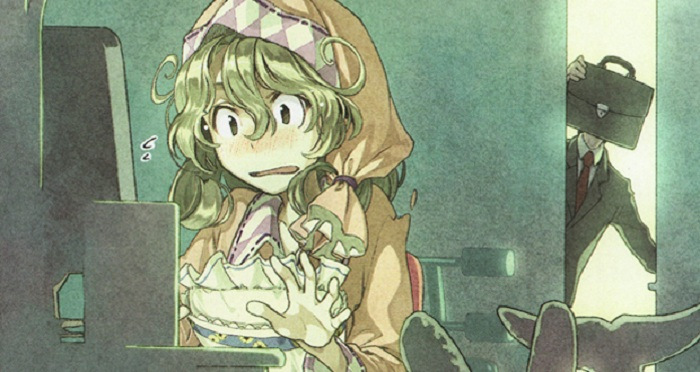
Upcoming Shaft anime Sasami-san@Ganbaranai serves as a great example that can guide us through the process of translating a “difficult” anime title. As I will be covering this admittedly gorgeous production during the Winter season, I have been thinking of a proper title to adress the show by. While the original title may not be as long or irrelevant as some of the worst examples, its sheer structural ineptness certainly got me thinking. Literally, the title would translate to something along the lines of Sasami@Not Doing Your Best or Sasami@No Good Luck. Given that the show is about Sasami Tsukuyomi, a lazy girl who refuses to even go to school, I am going to assume the former would be the most accurate. If we turn that into an actual English title, we would get Sasami Never Tries Her Best.

That is still a bit too long to be appealing, so we will continue our search a bit longer. By looking for synonyms of ‘never trying one’s best’, we can attempt to come up with a decent alliteration or pun. The plot summary tells us that Sasami passes her time watching the world by means of a “Brother Surveillance System”. It would be great if we were able to integrate this important plot device in our title. ‘Don’t bother’ is a synonym of ‘never trying one’s best’ and makes for easy wordplay with ‘brother’, so there must be something here. Can’t Be Brothered, maybe? Or how about we turn it around and make it Sister Slacker? We could even try to incorporate the @ sign from the original title, because it neatly accentuates Sasami’s affinity for computers. Sister Sl@cker, then? That could work… If it were the nineties.
From the plot premise we can derive numerous other lines of thought that can help us to come up with a nice title, though. This “Brother Surveillance System” is just too tasty to leave out. The first thing I think of whenever I hear the word “surveillance” would be Big Brother, the mysterious totalitarian dictator of Oceania from George Orwell’s 1984. The link from Big Brother to Little Sister is easily made, and while Little Sister as a title could carry some really unfortunate implications given the genre, Little Sister Is Watching You could make for a clever alternative. This is just one of the many inspirational trails you can follow in order to come up with a title that respects both the expectation of an anglophone audience and the style of the source material.
The use of this method is hardly ever limited to just titles. Every single line of translated text needs to be carefully considered. Translation is an endless and idealistic process and the few hardly professional possibilities I listed here are only so many of the thousand different and perfectly justifiable ways to translate Sasami-san@Ganbaranai. A translation is a problem that has countless wrong answers, and not a single correct one. Which name I will eventually call Sasami-san@Ganbaranai by when the coverage kicks off will depend mostly on whatever name the professional translators at whatever company that ends up licensing it will choose. If not, I’ll probably stick with the original Japanese. Even I don’t have the pretense to formally call a show by a name only I acknowledge it by. If I had, I’d force you all to call it Sasami and the Sibling Surveillance System. Nevertheless, thinking about translation is a very interesting thing to do, and a dialogue everyone can contribute to. We wouldn’t have anime without it.


 The Glorio Blog