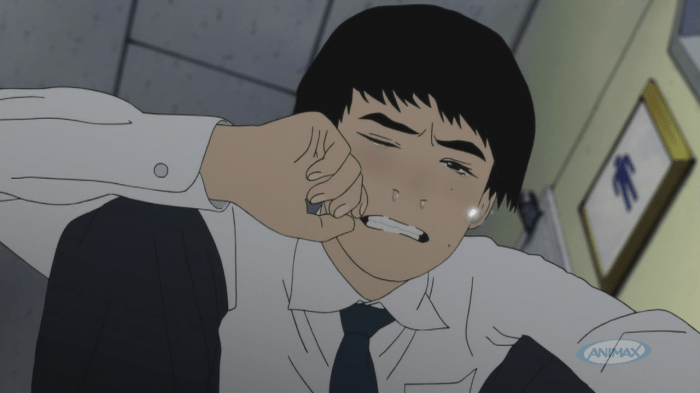
Boys don’t cry. Men do.
Recap: Kasuga’s standing up for Nakamura has earned him a lot of Saeki’s attention. He musters up the courage to ask her out, but as usual, Nakamura is a few steps ahead of him.
Looks like Nakamura now has her own profanity-loaded theme song as well. I’m not complaining, though I will miss that amazing guitar solo. Apparently, that was Takao’s version of the theme song, although I must say it dosn’t exactly fit him. Awesome is not the first thing I think off when I see a guy who is so obsessed with walloping in his own misery he cannot simply give Saeki her gym clothes back. Just like Shinji Ikari, however, he has to go through an unsurmountable series of trials all because he cannot possibly bring himself to disappoint that one, idealized version of a person they are not even all that close to. While this is about where the comparasions end, both boys are a nice example of characters who should alienate audiences with their constant angst, indecisiveness and bad decision making, but still earn people’s sympathy because of their nice and sometimes oddly relatable psychological profiling.
While I in no way want to imply that Flowers of Evil is on the same level as Neon Genesis Evangelion, the both of them do follow a very similar outlook on storytelling. Tying up a traditional bildungsroman — a story dealing with the coming of age or spiritual education of its main character — with implausible, messed up story devices is a plot setup Japanese fiction tends to be pretty good at. In anime, the psychological journey of self-discovery usually takes the form of bombastic horror rather than being grounded in reality. Tropes and twists usually inherent to thrillers get used in psychological drama shows, or the other way around. Even though its ‘horror’ or ‘thriller’ elements are not as explicit as in, say, Future Diary, The Flowers of Evil still falls squarely into this category. Whether it is bizzare giant aliens that need to be battled, surreal absurdity that needs to be made sense of or an inhumanly sadistic girl that needs to be dealt with, when done well, these unrealistic elements make the coming of age of the main character more evident. It’s the strange juxtaposition of “deep” and nutsy that makes these stories almost allegorical, rather than simply relatable.

Here’s your obligatory Sawa smirk of the week.
Because you should not get me wrong; even though there is nothing happening here that science cannot prove, The Flowers of Evil is not realistic. It is not an accurate representation of the cruelty of being a teenager, rather than an outright exaggeration, a nihilistic take on what would happen to vulnerable teenagers when they are pushed to the very edge. Yet I do not think that is a bad thing. It is not because of the events devolving here are a bit far-fetched, that the characters are not complex or even relatable, and that there is no message to be found here. Sometimes events need to be exaggerated to be properly told. A nice example of this would be Lord of the Flies. While everything that happens in that book could (more or less) happen in real life, the events that unfold are exaggerated all the more, just to make the underlying message more evident. The Flowers of Evil follows suit in its own little eccentric way, giving the usual “oh snap!” moments of thrillers a proper place in a deeper, more psychological context. Heck, Sawa even has her own scare chord. Fitting, because The Flowers of Evil can be a lot scarier than most shows that actually call themselves “horror”.


 The Glorio Blog