
Alternative title(s): 30-sai made Dotei Da to Mahotsukai ni Nareru rashii, CherryMaho
Manga Adaptation by Satelight
Streaming on Crunchyroll
Premise
In Japan, it is said that being a virgin at thirty will give you magic powers. Much to Kiyoshi Adachi’s shock, this oft-repeated canard turns out to be true when he discovers that thirty years of involuntary celibacy have granted him the ability to read minds. Could this power be what he needs to change his love live for the better?
Aqua’s verdict: Heartstopper
Contrary to what the ill-advised title may imply, Cherry Magic is not, in fact, the umpteenth isekai anime about a thirtysomething virgin getting hit by a truck and reawakening as a powerful sorcerer in another world. Instead, what we have here is a feel-good boys’ love comedy based on the apparently common (and puerile) idea among Japanese netizens that going without sex for thirty years is somehow so shameful it will cause the ghost of Shinzo Abe universe to take pity on you and give you magical powers.
In Adachi’s case, those “magical powers” are of the telepathic variety, giving our awkward hero the power to read the minds of the people he touches, be that intentionally or entirely by accident. It’s a set-up with a lot of comedic potential, but Cherry Magic mostly uses it as a stepping stone towards its actual premise — Adachi soon finds out that his charismatic coworker Kurosawa is harboring a secret crush on him, and now has to awkwardly fumble his way through interacting with Kurosawa as he tries to figure out his own feelings on the matter.
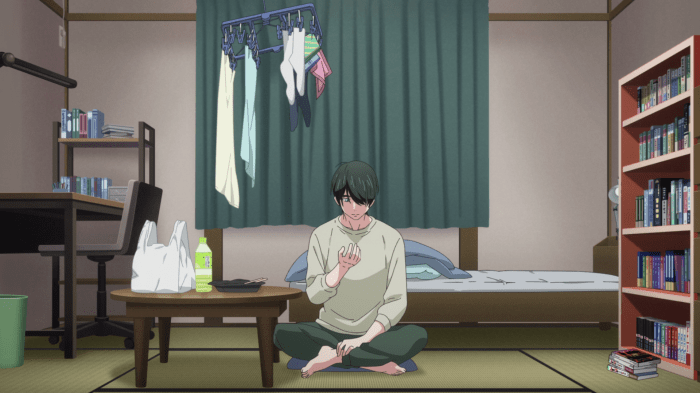
The result is a wholesome rom-com that smoothly navigates its way around the pitfalls the boys’ love genre is somewhat infamous for. Rather than portraying gay romance as overtly salacious, aggressive and laced in dubious consent, Cherry Magic focuses on endearment above all else, and it’s probably to this that the franchise owes its popularity, with a successful live-action adaptation having preceded this anime version in 2020. While that does make many of the character interactions veer towards the overly idealized or even twee, it’s admirable how this show finds a nice balance between sweet and playfully saucy. It never shies away from acknowledging that Kurosawa’s fantasies about Adachi can be quite raunchy, but makes sure to point out that he respects his crush’s boundaries above all else.
It’s a surprisingly mature approach towards sexuality for anime — in which having lustful thoughts is often portrayed as a tell-tale sign that a character is either a pathetic lecher or an active danger to any nubile specimens of said character’s preferred gender. In a medium in which men love monologuing about how “they might not be able to hold back” as soon as someone they might potentially be attracted to so much as looks in their direction, seeing sexual lust being used to render a character both more human and more humane, is quite rare.
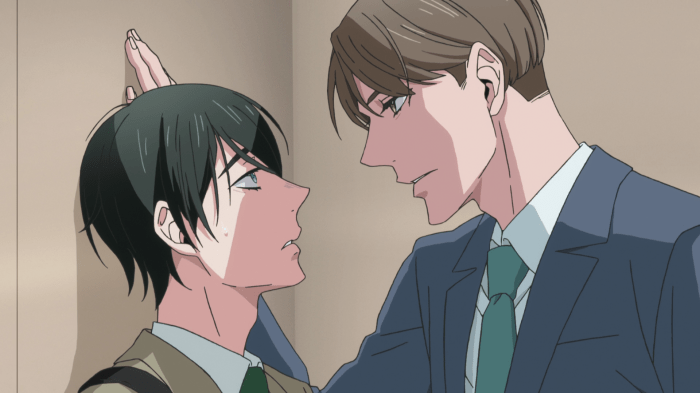
Unfortunately, this discrepancy between Kurosawa’s thoughts and his actions is kind of everything Cherry Magic has to show for itself. Most of the jokes in this first episode are some kind of spin on the same pattern: (1) Adachi thinks Kurosawa is going to try something funny. (2) Kurosawa does not, in fact, try anything funny, since he is actually a kind and respectful person who can control his impulses. (3) Adachi realizes that makes him like Kurosawa more.
There is nothing wrong with this per se, as the show is wise enough to weave the misunderstandings into Adachi’s own self-exploration to avoid things feeling too much like a repetitive 4-koma adaptation. It’s not necessarily what I like, though. For a wholesome rom-com like this to retain my attention, it needs to go all-in on riotous jokes. Otherwise, I do need some more psychological complexity for relationship drama — if you can even call Adachi’s befuddlement at Kurosawa’s affections that — to get me invested, and Cherry Magic just doesn’t feel very interested in going too over-the-top or too in-depth.
Still, it’s hard to deny or dismiss the overwhelming demand for queer romance that is allowed to be joyous and unapologetically fluffy — not as a vehicle for angst in the face of bigotry or for as exploitative sleaze for the straight gaze. If that is what you’re looking for, Cherry Magic — despite that preposterous title — seems like it fits the bill.


 The Glorio Blog