
Alternative title(s): Japanese title
Anime original by Wit Studio
Streaming on Max and Hulu
Premise
When the American government discovers a portal to another dimension, the ruthless Amanda Waller engineers a plot to send in a “suicide squad” of imprisoned supervillains. With nano bombs inserted into their necks to enforce total obedience, Harley Quinn, Deadshot, Clayface, Peacemaker and King Shark are promised a reduced sentence if they help Waller achieve her mysterious objectives in this world of magic and monsters.
Aqua’s verdict: So We’re Some Kind of Search Engine Optimization Squad?
Several years after its release in 2016, it’s quite surprising to observe that David Ayer’s infamously atrocious Suicide Squad, generally regarded as the absolute nadir of Warner Brothers’ miserable (first) attempt at creating a successful shared universe based on the heroes and villains of DC Comics, did end up having by far the largest cultural footprint out of all the stinkers in its cinematic franchise. Every subsequent portrayal of Harley Quinn has been based on Margot Robbie’s incarnation of the character; the gaudy, but grungy, neon-tinted aesthetic of the film has been mirrored time after time again by just about any video game attempting to market itself as “punk”; and the Suicide Squad themselves have arguably received more love from their owners than the goddamn Justice League in the years since, with a movie sequel in 2021 and video game earlier this year, the latter of which did the whole “being lambasted by critics and fans alike” spiel from the Ayer movie all over again.

With a batting average this underwhelming, why then hasn’t the Suicide Squad’s rapid ascent towards the superhero A-list been cut short? The answer is quite simple. The top brass at DC Comics have been infamously obsessed with the notion that superhero stories need to be “edgy” and “provocative” for actual decades now, and have continued to indulge the vocal minority of loyal fans who agree with them — see also: the whole “Snyder cut” debacle — over anyone else. So of course there’s a Suicide Squad anime now. To executives exclusively interested in catering to 14-year-olds who like to coerce their girlfriends into cosplaying as Harley Quinn and YouTube provocateurs who demand you to debate them on why, in fact, Batman should totally just kill people, it’s a match made in heaven. Anime still has a semblance of “punk” to it here in the West, as evidenced by Netflix’ insistence on calling every R-rated animated video game adaptation it produces “anime” even when not a single person who worked on it has been Japanese. Suicide Squad ISEKAI, however, is such a nakedly cynical, transparent ploy to create catnip laser-targeted towards a specific audience that it honestly feels unreal, the kind of pathetic plea for attention that is twenty years too late to have become an ironic cult classic in the vein of Prince of Persia: Warrior Within or the Shadow the Hedgehog game. And the worst thing of all is, it kind of even fails at being that.
For a project that seemingly only exists to sell itself as — and I quote — “most maddening worlds collide in an epic and violent fantasy” to Red Bull addicts, Suicide Squad ISEKAI plays things painfully safe. Explicitly naming yourself after a subgenre already infamous for swarming seasonal anime line-ups with entirely interchangeable, creatively bankrupt, perishable slop is one thing, but even the Suicide Squad part of the equation falls embarrassingly short of delivering the promised edge. In lieu of the campy, wacky characters the premise would allow for, the cast is comprised entirely of caricatured versions of familiar faces — with Peacemaker and King Shark especially just being carbon copies of their cinematic incarnations. Clayface is the only real dark horse inclusion to the roster, but unfortunately, his portrayal as a foppish dandy here makes him come across more like he’s auditioning for a role on the Harley Quinn season of The Bachelorette than like the tragic, gothic monster he’s supposed to be.
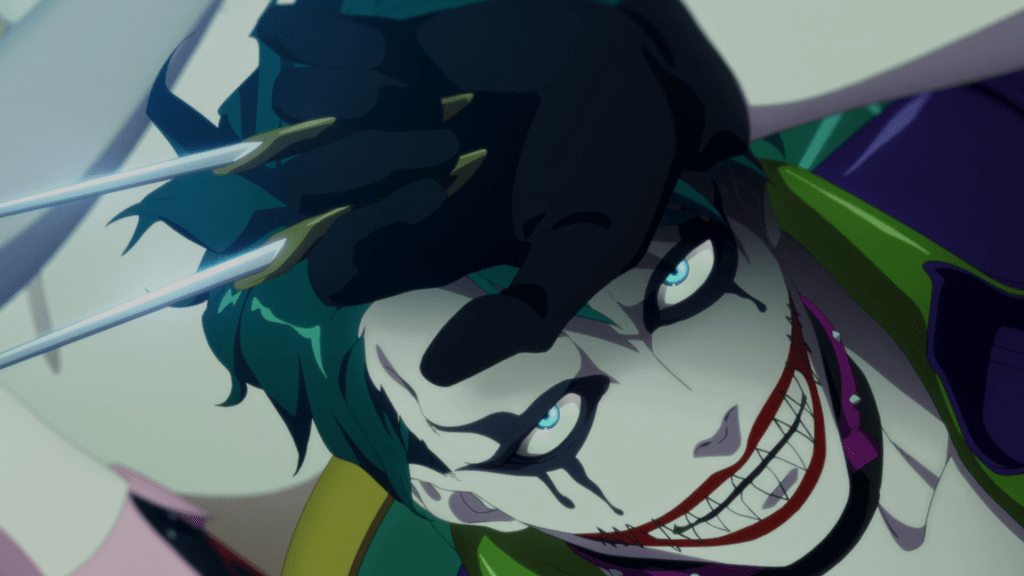
Speaking of Harley Quinn, this version of the maiden of mischief is so wishy-washy, throw-everything-at-the-wall-to-see-what-sticks that not even the character’s natural charisma can distract from how focus tested this whole project feels. ISEKAI‘s Harley is neither an unrepentant villain nor a pitiable victim of the Joker’s abuse — in fact, Mr. J himself seems to have been reinterpreted as a swashbuckling heartthrob who steals from the rich to give to the poor, in spite of his frankly repugnant redesign. Furthermore, Harley is not enough of an unpredictable psychopath to be entertaining, but not relatable enough to be the everygirl protagonist the show seemingly wants her to be — a decision so baffling it makes the fact that she also drops a pop-culture reference every other line now look brilliant in comparison. This lousy characterization, combined with the anodyne violence and general lack of a mean streak — to the extend where the Squad members don’t even really snark at each other — make Suicide Squad ISEKAI come across as the kind of project none of the creators involved actually wanted to be involved with. Then again, given the franchise’s recent track record, you could argue that’s par for the course for anyone not named “James Gunn”.
Does that mean this show is entirely without merit? Of course not. An anime production with this level of mainstream pedigree attached to it will at least look good, and the scrappy action scenes and snappy direction at the very least do what they need to do to bring a level of superficial excitement to what is otherwise a paint-by-numbers snorefest. If there is any grit to be detected in this project, it’s there in some of the experimental animation techniques the talented people at Wit put on display, from the rough and scraggly look of the hostages in the opening scene to the use of rotoscoping in the tussle between Harley and Katana prior to the former’s arrest. Otherwise though, Suicide Squad ISEKAI is a sloppy contradiction — a project on the same level as a T-shirt depicting the Mario brothers as Samuel L. Jackson and John Travolta in Pulp Fiction, a meaningless crossover of two popular things that exists solely to justify its own cultural legitimacy, only to fail at delivering even the most superficial of edge. It’s a band dressed in goth makeup and punk regalia, playing toothless arena pop. How ironic, then, that a company terrified of its iconic characters like Superman being regarded as simplistic and lame, continues to bet it all on depicting and marketing characters literally designed to have their heads explode for shock value in a way that couldn’t be any more simplistic and lame if it tried.

Zigg’s verdict: Belle Reve Blues
I’m firmly of the opinion that there has only been one point in history where the post-Silver Age Suicide Squad were anything other than unbearable tryhards, namely the original, John Ostrander-penned run between 1987 and 1992. Psychologically complex, shot through with pitch-black humour, and unafraid of focusing on truly obscure characters, it’s a classic which no subsequent iteration has equalled. Instead, as Aqua notes, the Squad these days are something of a byword for XTREME COOL EDGINESS and comically misplaced attempts to sell comic books as ‘adult’.
You might argue that it’s unfair to dump the baggage of DC/Warner’s mismanagement of the brand on this show, divorced as it is from any established continuity, but by trading on a recognisable name you have to take the rough with the smooth too. That means that, like it or not, Suicide Squad ISEKAI has to bear the weight of every part of its name. And really, that’s where the problem is, and it’s why despite the slick presentation on display I hated this even more than I thought I would.
To be clear, this is art as pure, 100% extruded product. Nobody sat down and had the idea for this show spring organically from their creative muse. There are Ikea shelves that are less pre-assembled than this show. Some marketing guys sat down, took one thing ‘the kids’ like (isekai anime) and mashed it up with another thing they like (Suicide Squad… in theory) and that’s about the extent of the inspiration that led to this. That’s not the fault of the directors or artists or animators, who do good solid work, but no amount of presentational flash can disguise the deeply hollow heart of the story. Hell, even the title is the laziest, most half-baked thing you could possibly come up with, a placeholder than someone forgot to swap out before airing. I’ve seen many shows that were worse than this, but only a precious few that were this cynical.


 The Glorio Blog