
Recap: Ao, Truth and Naru face off for the last time as Ao’s father, Renton Thurston, arrives to unravel the final mysteries of this world.
Dragonzigg’s Thoughts: It’s been a long and twisted road to arrive at the end, one full of half-realised hopes and horrible letdowns, a few bright spots and too many dark patches. In many ways these final two episodes serve as a perfect encapsulation of Ao as a whole. They’re ambitious, toy with potentially interesting concepts and make valiant attempts to tug at our heartstrings, yet ultimately still fall hugely short in critical ways.
Let’s begin with the resolution of the Truth plot line, because it’s by far and away the worst part of these episodes. In fact, even calling it a resolution feels misleading, as it’s more a series of desperate actions that have practically no connection to each other. I can imagine the writers only just coming to the realisation that the rest of us had a long time ago, namely that the supposed main villain of the show has in fact practically nothing to do with it. As it is, his removal from the plot feels brutally mechanical in the worst possible way – there’s no closure or climax to his story, it just sort of…stops. Take note of this, because it’s a criticism we’ll be using an awful lot.
As it is, the indecisiveness of the situation is palpable – first he’s defeated, then he isn’t, and then he suddenly is again, in the way that will cause the least possible fallout to the rest of the story. The Quartz gun has long been one of the most interesting parts of the Ao mythology, but its use against Truth is a perfect demonstration of how badly you can screw up something like that. I complain a lot about Truth being entirely inconsequential to the plot (hey look, I did it in the last paragraph!) but if you simply remove him from the story wholesale, as the Quartz gun purports to do, then surely the story changes more than just giving the Nirvash a sweet fin? It reeks of laziness and an inability to properly resolve the character. Though the cause is not time travel here, it’s something that many time travel stories suffer from – if you’re going to change the history of your show, you must do your due diligence and not just slap a fresh coat of paint on. Simple example – if Truth never existed, why is Naru even in the same area, fighting Ao?

Speaking of Naru, her ending, such as it is, is equally undignified. I really thought that after her heart to heart with Ao in episode 22 we might see a bit more affection between them, and maybe an aspect to her character other than ‘annoying’, but instead she goes straight back to that well, helping (?) Truth and then fighting Ao, before being put into a coma for the rest of the show. It’s so slapdash it feels like something out of an afternoon soap opera. Character giving you trouble? Put them in a coma! It’s a bitter and entirely unsatisfactory sendoff for a character who was, judging by all the promotional material, meant to have a much bigger role. That clearly changed, and instead she’s had to mill around on the sidelines, bereft of functionality or purpose.
In fact, that thing which plagues these two characters is what plagues the whole of this ending in general. The decision to focus on the Ao/Renton axis, which does pay dividends as we’ll see later, effectively means everything else has to be shunted to the sidelines. Thus, once Ao disappears back in time, that’s your lot. We get nothing on the fates of Pied Piper, Naru, Ao’s grandfather or anybody else – they’re simply left hanging in limbo, awaiting an uncertain fate. For any piece of fiction, this is simply inexcusable. You’ve asked us to devote all of this time and interest into these characters, and then we’re not even furnished with such basic information as whether they live or die, or what their fates may be. Again, lazy writing which smacks of too much story and not enough time, poor planning and questionable management. Characters like Fleur and Elena weren’t the greatest ever, but if you spend 24 episodes with them you’re going to develop a certain affection and I felt cheated by not seeing the end of their stories as well.

If there’s a strength to this finale, it lies in the Ao plotline, which finally sees him reuniting with his parents, albeit in a less than ideal manner. This show has involved so little of people just sitting down and talking with each other that it’s rather refreshing when it actually happens, and these two episodes feature some strong dialogue sequences. My favourite is the one where Renton and Ao have a kick-about in the back yard, because it’s both a callback to the original series and a neat juxtaposition of a traditional father/son activity onto an unfamiliar situation. Sure, it’s also an excuse for an infodump, but the infodump is kinda necessary, and placing it in an emotionally resonant scene like this makes sense.
The one thing for me that raises this finale above mediocrity, and makes it an interesting and worthwhile watch, is the revelation about the fate of Ao’s sister. The show has thrown out red herrings and then chickened out of resolving them so many times I’d pretty much assumed that would also be the case here, but instead we get what the show so desperately needed – a one-two punch of a crushing emotional blow and an excellent plot twist. It’s simply heartbreaking to see Renton and Eureka weeping by an open grave, and entirely believable that they’d go as far as seeking another world to achieve their dream of starting a family. It also plugs a crucial plot hole, by giving Eureka a reason to be opposing the Scub Coral, who are after all her own flesh and blood. My one major problem is that I find it difficult to believe Renton and Eureka would abandon Ao at any cost – they’ve already lost one child, so you’d assume they’d do whatever it took to avoid being separated from another forever. Nevertheless, it’s a powerful moment worthy of a series climax.

As for the ending itself…it’s kind of odd I guess. I’m not even going to dwell on how the Quartz gun magically has the power to open holes to other universes – that’s clearly just a case of ‘because the plot says so’ and I’ve already expressed my displeasure at the lack of any sort of resolution for any of the other characters. But I’ve always had a weird affection for bittersweet ‘Flying Dutchman’ endings, where characters are left to walk the world forever, and that’s basically what this is. There’s an odd, sad poetry about Ao being left alone in a world where he and his friends may not even exist anymore, where he can start afresh and anew. If anything, it’s an apt metaphor for the show itself – for better or worse, let it go and begin all over again.
Random Observations
– I haven’t said anything about Truth reincarnating as the Neo-Nirvash’s archetype, because I trust its unbelievable stupidity speaks for itself.
– Why even bring up the archetype thing anyway? It has precisely zero impact.
– Nice to see the credits evolve one more time as Renton glances over his shoulder.
– Adult Renton’s voice actor also played Holland in the original series, which means anyone who’s seen both will get pretty confused.
– These episodes look pretty great most of the time, but there’s still some bad stuff in the long shots.
– Love the line where Ao sees the moon and remarks ‘That’s so embarrassing’
– There are rumours that the last BD/DVD may contain a bonus OVA. I’d welcome it, though it’d be difficult to do something post series without destroying the mystique of the ending.

Final Impressions: Following Ao from beginning to end has been a fascinating experience. As a rule, I don’t watch bad shows, but having to do so to keep up with coverage has taught me a lot about writing criticism and about the ways a narrative can work. In a way, I’ve become oddly fond of Ao and it’s weird thinking that there won’t be any more of it.
But I’m pretty sure any warm and fuzzy feelings are just the results of Stockholm Syndrome getting the better of me. Let’s put it bluntly – this was a poor show, and at times a shockingly bad one. Only rarely did it manage to rise above mediocrity, and too often it felt as though it was hopelessly lost with no place to go. I’ve never seen any piece of media that more desperately needed a firm, guiding hand on the tiller. That ultimately was the show’s downfall. There are the seeds of several good stories rooted in Ao’s madness (albeit seeds that have already been explored by other, far better shows) but without direction or a decent script, they just sort of mishmashed into a mess of dangling plot threads.
The writing has been sloppy, ill thought out and badly paced throughout, unable to sustain some of the more intriguing mysteries that briefly powered the show, such as the dilemma of the multiple Eurekas. In other places, it appeared content that the audience would simply take proceedings on faith with little to no justification (remember Miller? What was up with that?). Worst of all was when it dangled blatant plot red herrings in front of us only to later reveal that they had nothing to do with anything at all. Elena’s true identity and the lurking presence of TheEND were the most egregious examples of this, and the lacklustre way these were brushed aside gave me and many others real distaste for the show, and an inability to trust the narrative.

Plot inaccuracies may have been excusable had the cast been any fun to spend time with, but the writers sunk so much into their bullshit plot that we get precious little time to learn about our protagonists and understand them as people. As shonen heroes go Ao is fine but bland, wishy-washy and devoid of notable characteristics. Fleur has the most chance of anybody of actually becoming an interesting personality – sure, daddy issues are a well trodden path, but at least she has some gristle to her character – but bad writing buries her as an unlikeable bitch, and the tiny hints of romantic tension she has with Ao never go anywhere. Elena is either a catchphrase spouting fanservice machine, or an emotional wreck, and appears to have no gear between the two. None of the have much appreciable depth, or are relatable in the slightest. In fact, of all the main cast, only Ivica really emerges with dignity intact, providing a strong, no-nonsense character to anchor the team in something approaching reality. Oh and Noah, Noah is awesome. Perhaps Naru suffers the most, as despite her alleged closeness to Ao she spends the vast majority of the series apart from him, flip-flops between motivations, characterisations and sides endlessly, and we never get any sort of insight into her character. She’s symptomatic of everything wrong with the character writing in the show.

One argument I’ve heard in the show’s favour is that it’s not trying to be Eureka Seven and it should be judged on its own merits. As I’ve just made clear, I don’t think those merits are very impressive regardless, but what really blows this argument apart for me is that when the show does manage a strong moment, they’re almost entirely centred around its connection to the older show. It’s no coincidence that in my mind the best episode of the series is Episode 12, where Ao and his mother get to have a quiet heart-to-heart moment together. By piggybacking on the nostalgia we have for its predecessor Ao was able to draw some measure of the fierce emotional attachment we felt for those characters onto itself – an attachment that far outweighed anything I felt for anyone in Ao. Sequels are doomed to comparison with their forebears, whether that’s fair or not, and Ao fell short in every regard. Eureka Seven was famed for its effortless romanticism and freewheeling spirit; with its stodgy focus on political wrangling and fractured, tedious interpersonal relationships, Ao couldn’t be further from the spirit of its predecessor.

Ultimately, that’s the rub. Ao could never have hoped to match up to Eureka Seven, but the degree to which it fell short was alarming. Even if you stripped the away the name and filed off the serial numbers, this would not be a good show – it’s too broken fundamentally on the narrative level. But with those elements back on, the disappointment was even more crushing. Given the poisonous fan reaction, mediocre sales and general lack of interest, I can safely see Ao slipping gently into irrelevance over time, becoming nothing more than a piece of obscure trivia or the punchline to a joke – a modern day Dragon Ball GT if you will. That’s a shame, because the show had some brave and interesting ideas, and some genuinely cool moments. Perhaps history will judge it more kindly out from under the shadow of its parent show. I mean, was Eureka Seven really that great anyway?
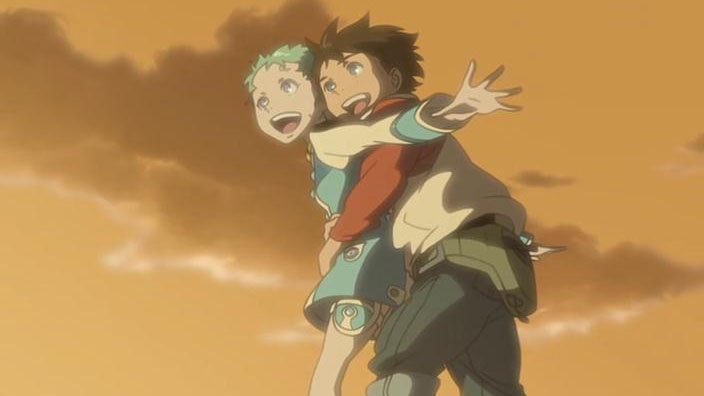
FUCK YES IT WAS.
That’s it people. Thank you for everyone who’s watched and read along with me, it’s been lots of fun. Catch you on the next wave.


 The Glorio Blog