
Alternative title: Takopii no Genzai
Manga Adaptation by Enishiya
Streaming on Crunchyroll
Premise
Takopi, an alien from planet Happy, crash-lands on Earth to fulfil his lifelong goal of spreading joy across the universe, and meets 9-year-old Shizuka Kuze, who is subjected to relentless bullying from her classmates. Determined to save Shizuka from her miserable predicament, Takopi quickly finds out that happiness is a lot harder to find than it might seem…
Aqua’s verdict: Sweet Sorrow
Takopi’s Original Sin is the first anime I’ve ever seen to come with an unironic content warning from Crunchyroll. It should not be taken lightly. This is an unflinching, unremitting descent into the depths of cruelty children can inflict onto each other and onto themselves when abuse, apathy and incompetence are all they get from the adults around them. Anime is no stranger to frank depictions of cruel bullying and ostracisation, but in line with the medium’s penchant for emotional intensity and melodrama, these portrayals are often pantomime, too mawkish to be taken remotely seriously. Takopi’s Original Sin strips away these affectations and depicts the callousness for what it really is — fuelled by petty grievances, heartless prejudice and above all, a desire to lash out against anyone for any reason.

Yet what makes Takopi’s Original Sin‘s depiction of bullying and abuse stand out isn’t necessarily the how of it, but the why. Usually the inciting incident of a story is what offers the main character a way out of their misery. In this one, however, the titular squishy alien’s desperate, yet gullible attempts to make like a Doraemon or a Fairly Odd Parent, might just end up making things worse for his chosen ward. Shielding Shizuka from vicious pranks only makes her tormentors up the ante in retaliation. Impersonating her gives them more ammo to fire at her. Showing her a glimpse of hope only reminds her of what she can never have. It’s a harrowing reminder that ostracisation and abuse are more than outside inconveniences that can be easily excised. It seems that no matter what Takopi does, Shizuka will end up suffering, as if the trauma has become the very fibre of her being.
It’s perhaps odd, then, that a show primarily concerned with such grim and weighty matters also spends a lot of its runtime on the saccharine shenanigans of a cartoon cephalopod. Oozing with optimism and a gullibility usually reserved only for the most spineless of establishment politicians, Takopi stretches and squeezes, buoyantly bounces around the screen and occasionally even switches art styles entirely; providing levity, albeit of the blackest possible variety. I’ll be honest, I could see even viewers who can stomach the emotional lashing of Takopi’s Original Sin dismiss this kind of tonal whiplash as ill-advised at best and outright gauche at worst.
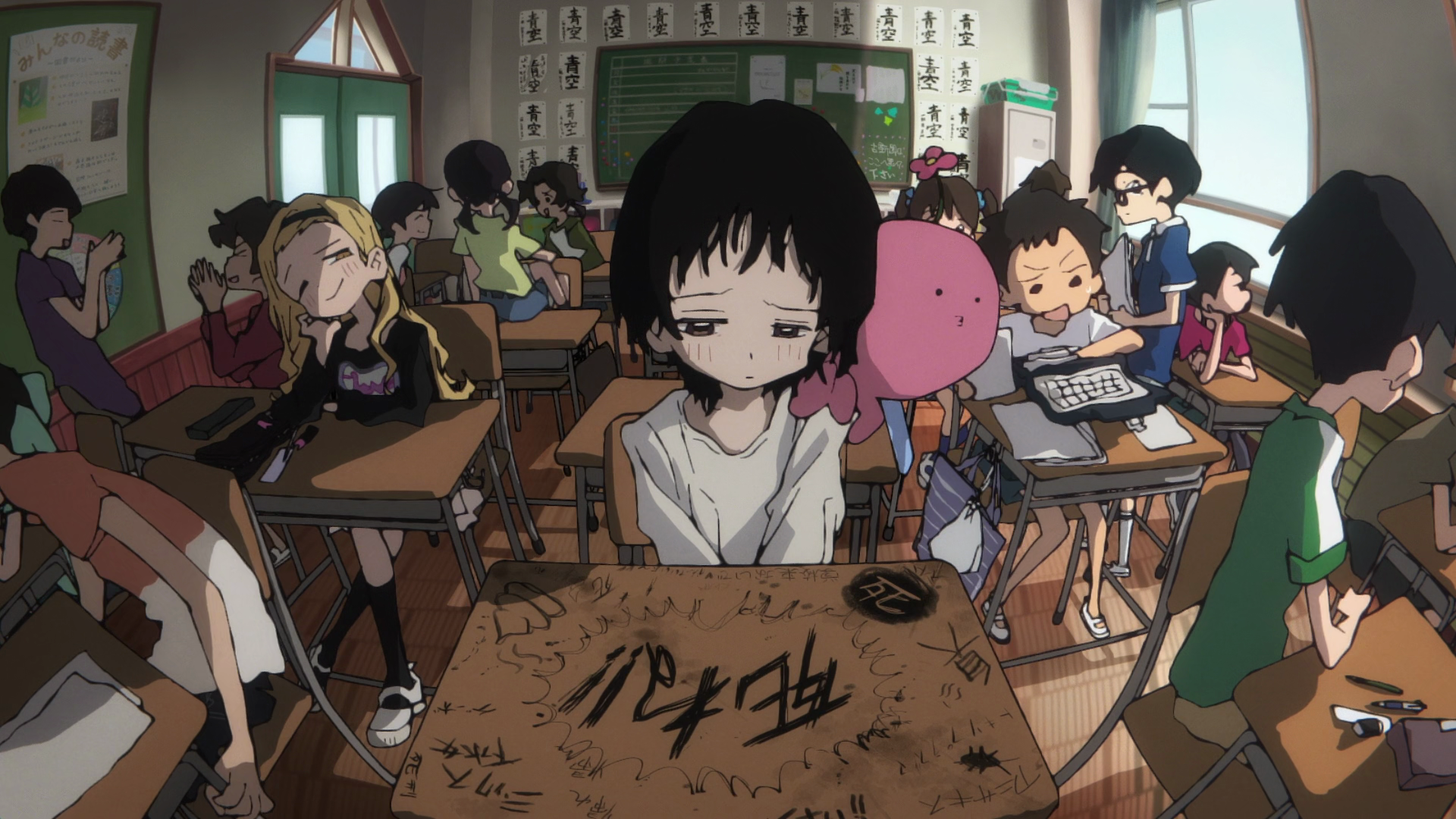
It sounds like an atrocious idea on paper, a remake of Requiem for a Dream starring Elmo in the lead role, or a Barbie movie casting the glamorous doll as a single mother drowning under the crushing weight of medical debt. Yet time after time again, this medium has shown that it can make these kinds of contrasts work. Inio Asano1 never stopped drawing the protagonist of his coming-of-age epic as a crude caricature, not even when the whole thing devolved into a nihilist death march towards inevitable despair, and Goodnight Punpun would have only been half as memorable if he had. Tonal whiplash is a delicate balancing exercise, but anime happens to be an excellent rope dancer.
Heck, if there’s any show Takopi’s Original Sin reminds me of, it’s that other show about an art-style-agnostic pink creature that can’t help but shoot itself in the foot continuously — Bocchi the Rock. As with Bocchi the Rock, Takopi’s Original Sin leaves in the middle whether it’s its protagonist, or the world around them that is supposed to be the butt of the joke. Sure, Bocchi the Rock may get a lot of laughs out of Hitori Gotoh’s social incompetence, it never delegitimises her feelings or her flaws, which while ostensibly contradictory or potentially offensive, mirrors how many actual people look at their own anxieties. Takopi’s Original Sin posits a similar contrast — does Takopi deserve to be depicted as a buffoon for his desperate attempts to bring joy to a world so clearly bereft of it, or is the joy said buffoonery brings one of the few weapons we have against the misery of our existence?

Suffice to say, Takopi’s Original Sin provides far more to ponder over than merely the cruelty of man, even if you somehow lack the desire to mull over the misery of our existence on this planet, or the inherent desire to empathise with an extraterrestrial spaldeen who can’t go a single sentence without reminding you of his speech quirk. The production is nothing short of excellent, combining a rough, visceral art style matching both the story’s grounded cynicism and its occasional foray into cartoonish bombast with a soundtrack that is as whimsical as it is subtly menacing. Takopi’s Original Sin also has the dubious honour of being the rare example of how the streaming format can benefit anime creatively — with both the number of episodes it has and the length of these episodes having been determined in function of the story it wants to tell, as opposed to vice-versa.
In the end, raw honesty and immaculate artistic genius don’t just make Takopi’s Original Sin a resounding cry for a glimmer of hope and empathy in this unfeeling world, but also an easy contender for the one anime to watch this season. It might be tough — or for some even impossible, and honestly, I can’t blame you — to cross its treacherous waters, but there’s a promised land on the other side.
- Perhaps unsurprisingly, there are a lot of similarities between Takopi’s Original Sin and the flashback episode of last year’s Dead Dead Demons Dededededestruction, which adapted another manga by Inio Asano. ↩︎


 The Glorio Blog
I couldn’t finish reading Good Night, Punpun because of how depressing it was. Heck, I stopped watching Re:Zero after the cringey incel speech the main character did when the love interest wouldn’t initially return his affections. Bocchi the Rock is probably my optimum level of this type of narrative discomfort, so I don’t think I’m watching this anime. I appreciate the write-up, though.
I completely understand! Based on my experience talking to others about it, it seems to me you can only really unconditionally enjoy reading Goodnight Punpun as much as I do if you take a strictly analytical approach to seeing tragedy depicted.
I can appreciate how stories use narrative devices to effectively elicit an emotional response, but I’m not generally the kind of person who will, say, get depressed from reading a depressing story. I am empathetic, but not sympathetic, if that makes sense.
Whereas if you’re a person who reads with their heart instead of with their head, I can totally see why you’d want to avoid thoroughly depressing stories or even fail to see their point other than to make you miserable.
Regarding what you said about Re:Zero; I haven’t seen that show, but it does make me wonder whether the point of that scene was to depict the character as a pathetic, entitled piece of shit who needs to learn and get better, or if the point was to make viewers feel sympathy for him because the girl doesn’t love him back even though he “deserves” it.
In the former case, I would have no problem with this as long as the narrative doesn’t bend over backwards to indulge him, but then again… anime so often does exactly that, pandering to incels and their belief that women only exist for the emotional and sexual gratification of men, that I can’t help but think the intention was probably the latter.
I mean, the whole reason why I’ve never watched Re:Zero is because it looks to me to be nearly identical to the quadrillion other isekai anime that exist solely to be hollow power fantasies, so… I dunno.
Sorry, only seeing this now, I haven’t been using WordPress a lot lately. The character apparently gets better after this low point but that was basically it for me. I’ve got a decent tolerance for isekai BS but as you said, there’s a lot of isekai out there, so why stay when you get squicked out? I think I got the gist of Re:Zero, anyway.
I’m torn. I liked it in an abstract sense, it’s a well told story, but the double episode was hard to stomach. I suppose the worry was it would be too dark to leave episode one on the suicide?