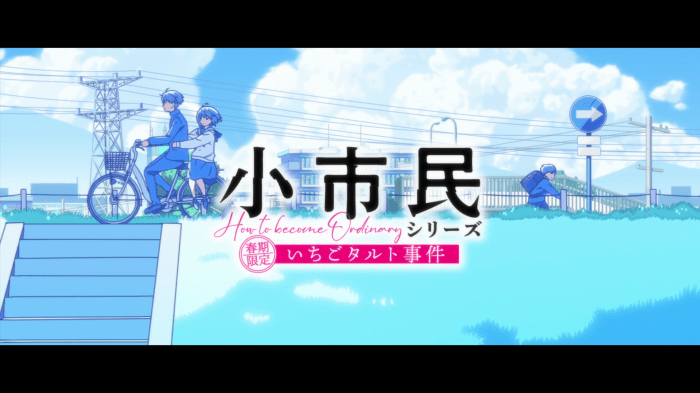
Alternative title(s): Shoushimin Series
Novel adaptation by Lapin Track
Streaming on Crunchyroll
Premise
He’s a genius at deduction. She’s really into confectionery. Together, they solve incredibly mundane mysteries and try to survive high school.
Aqua’s verdict: I’m curious!
I think Iro really hit the nail on its head when we discussed Shoshimin‘s upcoming release on the podcast. Hyouka, the 2012 detective series by Kyoto Animation, in which a cynical slacker and his ever-curious, excitable not-a-girlfriend solve the most mundane of mysteries as they navigate their way through high school, is generally fondly remembered, but can anyone actually accurately recount what happened in that show? What it was about? There are bits and pieces that have stuck around in my memory, for sure — the cook-off episode, Oreki doing a Sherlock Holmes impression as he catches a classmate smoking, the cheesy “ice cream” pun — but the truth is that a lot of Hyouka has, to us here at The Glorio Blog, kind of evaporated into little more than a fleeting vibe, a production in the end better known for its stunning presentation than its story or characters.
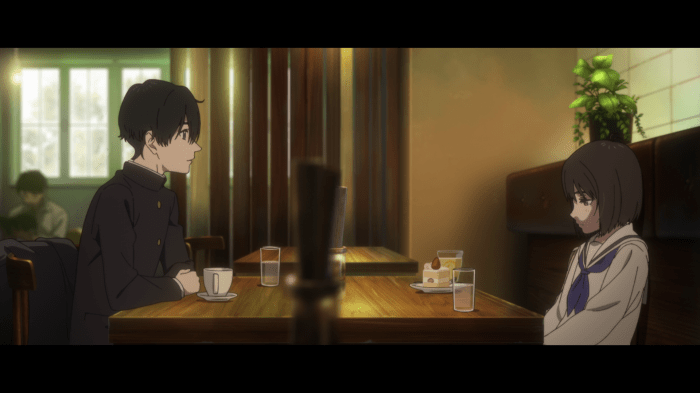
That is not to say Hyouka was a footnote in anime history. It was arguably the series that capped off KyoAni’s transition from a production house predominantly known for otaku-centered visual novel adaptations and viral comedies to a studio synonymous with lavish, cinematic spectacle, mature in how it raised the bar for television anime, yet ever still obsessed with the springtime of youth. It was arguably one of the first truly prestigious slice of life anime, showing off that subtle character animation, atmosphere and directorial flourishes more at home in arthouse indie movies than in blockbuster action spectacles had as much of a home in the medium as flashy sakuga, colourful zaniness and meticulous action choreography had.
Now, more than ten years later, this approach Hyouka took to its source material has become a new standard. P.A. Works have essentially made it their whole brand, and with shows like A Place Further Than the Universe, Bloom Into You, Super Cub or Given — not to mention the masterpieces Kyoto Animation would go on to produce — fans of the subtler side of the anime art form have been eating well over the past decade. This, however, poses a bit of a problem for Shoshimin, a show quite transparently being pushed as Hyouka‘s spiritual successor. Despite Kyoto Animation no longer being involved, Shoushimin is a production that is, at least artistically, at the same level of quality as the 2012 show, with stunning character animation, confident directing and an exuberant eye for detail. In the end, however, it illustrates that merely looking and feeling as good as it does in this day and age isn’t enough to stand out from the crowd.
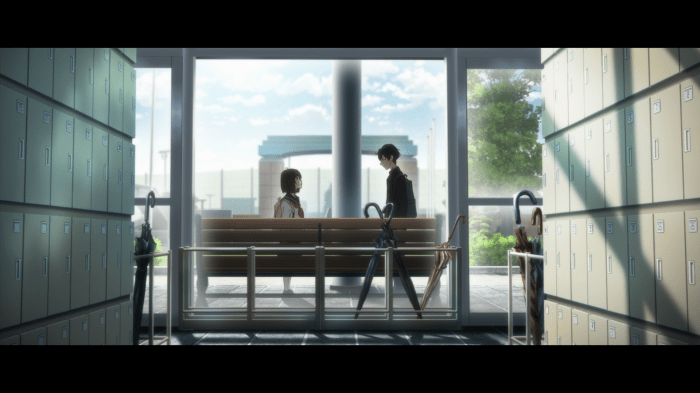
It’s not hard to describe where exactly Shoshimin, at least in this first episode, kind of fumbles the ball. It’s kind of boring. It’s inconsequential. It’s distant. The central mystery our main character is essentially browbeat into solving is almost comically mundane, and its resolution is thoroughly unsatisfying, hinged entirely on far-fetched interpretations of seemingly random details being taken for unambiguous truths and information withheld from the audience because god forbid they crack the case before the smartest boy in the room does — all the hallmarks of bad mystery writing. This arguably wouldn’t be a problem if the stakes were high and the excitement came from the implications of the nonsensical mystery — we here at The Glorio Blog are certainly not against a healthy dose of bullshit in our detective stories — but unfortunately, we’re not dealing with a murder here, but with a stolen handbag.
It’s honestly quite the challenge to imagine what made any of the writers involved believe anyone could possibly care about the sheer banality of what Shoushimin has on offer. When the episode ends on the cliffhanger of — *gasp* — Kobato’s bike getting stolen and — shock! — the strawberry tarts our main characters spent all episode looking forward to eating getting happy-birthday-to-the-grounded, it’s hard to resist the feeling that this show is already starting to feel like a parody of itself. What’s next? A three-episode arc where our intrepid hero enters his mind palace to deduce where the television remote could be? Cinematic splendour can be a large part of a show’s appeal, but you do need something to keep people glued to the screen, and unfortunately, Shoushimin gets dangerously close to taking itself for granted.

Nevertheless, there is too much potential here to write Shoushimin off entirely. I am quite fond of the dynamic between our main characters, for starters. Seeing a boy and a girl who have been best buds for years is quite refreshing in a medium where stories tend to start with meet-cutes, and while I don’t doubt Kobato and Osanai will eventually fall in love, the warmth they show one another is a thousand times more naturalistic than the hormonal fumbling we usually get from couples like this. They feel like genuine outcasts, too, Kobato quickly being established as a doormat who doesn’t deal well with the assertiveness of his more extroverted classmates, while Oganai’s hyper-fixation on strawberry tarts, up to and including drafting a schedule for how she’s going to acquire them, couldn’t be more autistic-coded if it tried.
It’s enough to convince me this show has more up its sleeve than what it might have given away in this first episode. Its climactic thesis statement, an affirmation of Kobato and Oganai’s drive to help one another to become “ordinary people”, is writ large across the screen with such youthful, exuberant flair it makes the “we are infinite” scene from The Perks of Being a Wallflower look dull in comparison. The irony, of course, is obvious. In many ways, Kobato and Oganai are far more “ordinary” than their peers, who despite their more socially acceptable demeanour, lack the self-awareness to realize that stealing the bag of the girl you love so you can slip in a love letter, or strong-arming a classmate you barely know into helping you look for it when they clearly have better things to do, is complete sociopath behaviour. Yet in the bizarre world of teenagers, this is what is considered “normal” in comparison to, say, really looking forward to eating a nice piece of cake.
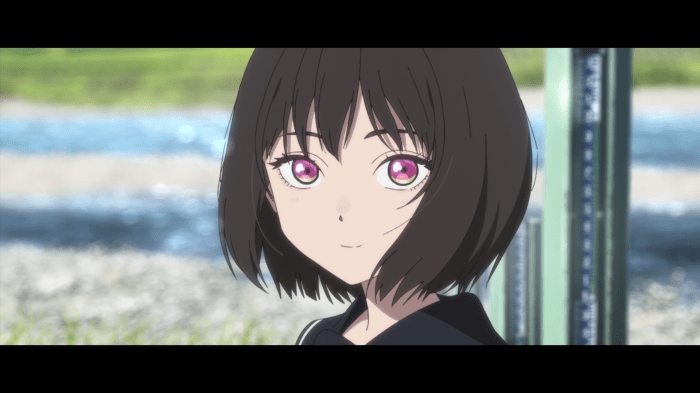
I really can’t help but to relate to that irony in a rather profound way, so if this is the direction Shoushimin wants to take things in, I’ll gladly be along for the ride, flaccid mysteries be damned. I know that’s a stretch. Maybe I’m just projecting. Maybe this show does not deserve the benefit of the doubt. There is hint of profundity to it, however, that makes me see Shoushimin as more of the sum of its parts. In a way, that does make it exciting. This show can no longer set a new standard for cinematic excess like its predecessor did, so it will have to prove itself in some other way. Perhaps, ten years from now, we will remember Shoushimin for the exact opposite reasons to the ones we have to remember Hyouka, not as an audiovisual trailblazer, but as vessel for characters and themes we’ll carry with us for the rest of our lives. Or maybe I’m just trying to draw blood from a stone.


 The Glorio Blog
Oh, I didn’t know this was a mystery! I’ve been looking for a new anime mystery. I’ll have to try this one out. I mean, the animation does look really good, so I would probably like it a little even if the mystery wasn’t that good.
If you’re looking for other great anime mysteries, I can recommend uuuuuuuuuuuuuuuh
Odd Taxi?
I guess that one counts! Yes, I can recommend Odd Taxi and uuuuuuuuuuuuuuuh
I don’t know what to make of this one quite yet. It’s going to get my standard three-episode test.
Yeah, it’s gonna have to focus more on the characters and the themes of “being ordinary” for me than on those half-assed mysteries.